
IMAN
The Chessboard Analogy: Understanding Allah Through Essence, Attributes and Actions
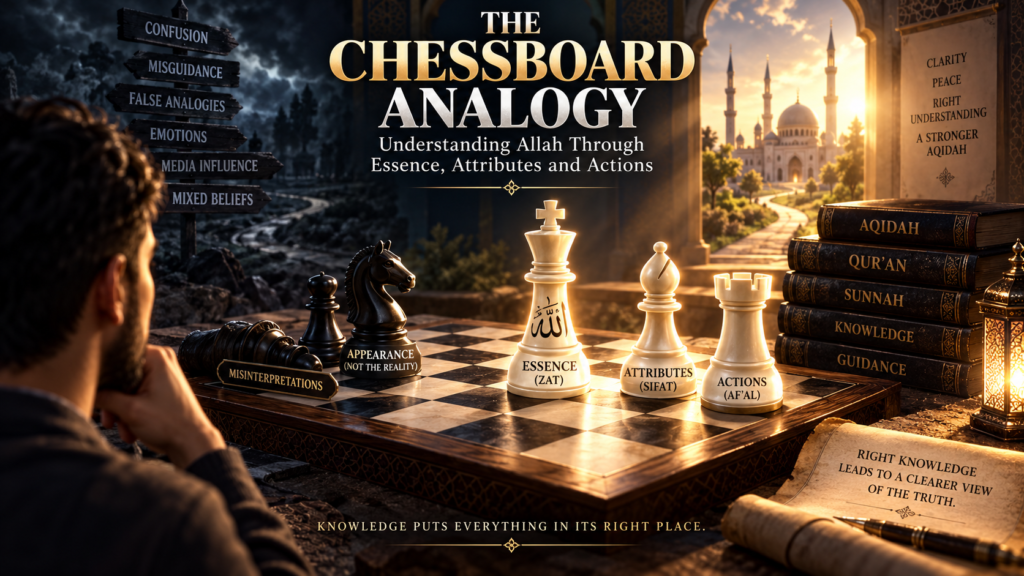
The first principle must be firmly established:
ATTRIBUTES ARE NOT THINGS.
White is not an object.
Black is not an object.
Colour is not an entity that exists independently.
It is merely a description of that which bears the colour.
Consider a chessboard.
The board is the bearer.
Black and white are attributes of colour.
The arrangement of its squares is the manifestation of those attributes on the board.
Without the board, we do not have a chessboard that bears this arrangement of colours.
If the board exists but its colours are not manifested, we have not yet seen the chessboard in the form we recognise.
Therefore, the analogy is:
Board = bearer
Black and white = attributes/descriptions
The manifested arrangement of squares = af‘al, or manifestation
Colour does not move on its own.
Colour does not stand independently.
Colour does not become the board.
But the board bears and manifests the descriptions of colour.
This is where the analogy helps us understand why we must be careful when speaking about Allah.
We are not saying that Allah is a chessboard. Far from it.
The chessboard is merely a logical tool for understanding one fundamental principle:
A DESCRIPTION IS NOT THE BEARER OF THAT DESCRIPTION.
⸻
IF COLOUR IS TREATED AS AN OBJECT, UNDERSTANDING BECOMES FIXED ON ONE POLE
Now imagine someone making a mistake from the beginning by assuming that:
WHITE is an object.
That person will then insist:
“This is the true colour.”
When black appears, they will see it as something that negates, damages or invalidates white.
Eventually, they will say:
“Keep white. Discard black.”
This is where the category error begins.
Because white and black are not two objects competing for the same place.
They are two descriptions of colour that exist together on a single bearer.
If only white is accepted and black is rejected, the chessboard loses its completeness as a chessboard.
The same applies if only black is accepted.
The completeness of the pattern emerges when:
white and black exist together in their respective places.
Therefore, the point is:
ONE POLE ALONE DOES NOT REVEAL THE COMPLETENESS OF THE BEARER OF ATTRIBUTES.
⸻
ITS CONNECTION TO NECESSARY AND IMPOSSIBLE ATTRIBUTES
In Aqaid 50, people are commonly taught:
Necessary attributes — accept them.
Impossible attributes — discard them.
But if attributes are understood as objects, this is indeed how the mind will operate.
One is accepted.
The other is rejected.
One is regarded as “true”.
The other is regarded as “unnecessary”.
Yet we have already established:
ATTRIBUTES ARE NOT THINGS.
Therefore, necessary attributes and impossible attributes cannot be treated as two objects.
They are two descriptions that exist together within a single field of meaning.
For example:
Wujud ↔ ‘Adam
Qidam ↔ Huduth
Baqa’ ↔ Fana’
Siddiq ↔ Kizb
Amanah ↔ Khianah
One does not need to be “discarded” as though it were an object.
What needs to be understood is:
what both poles describe about the bearer of the attributes.
Just like the chessboard:
White is not something to be kept while black is discarded.
Both are needed to read the board’s complete structure.
Likewise:
NECESSARY AND IMPOSSIBLE ATTRIBUTES ARE NOT A SYSTEM OF “ACCEPT AND DISCARD”.
Rather, they are:
TWO POLES OF DESCRIPTION THAT ARE READ TOGETHER TO UNDERSTAND THE BEARER OF ATTRIBUTES COMPLETELY.
⸻
ALLAH: ESSENCE, ATTRIBUTES AND ACTIONS
Within this framework:
Essence (Zat) — the reality of the bearer of descriptions.
Attributes (Sifat) — descriptions of the Essence.
Actions (Af‘al) — the manifestations or effects of the attributes.
Therefore, when we say:
All-Knowing,
All-Powerful,
All-Hearing,
All-Seeing,
Most Merciful,
Az-Zahir,
Al-Batin,
none of these are objects standing beside Allah.
They are descriptions.
Just as “white” is not a second object sitting beside the board.
The problem begins when the mind takes an attribute and then unconsciously constructs an unseen object as the bearer of that attribute.
The mouth says:
“Allah is not an object.”
But within the mind, there is still:
“an unseen entity that is extremely large, extremely high, located somewhere and possesses certain attributes.”
This is where the tongue and the mind may carry two different understandings of aqidah.
The tongue denies that Allah is an object.
The imagination constructs an object.
The Quran contains many verses which, if merely memorised without the discipline of understanding the language of attributes, relationships and actions, can be drawn by human imagination into the depiction of an object.
The following are ten examples.
⸻
1. لَيْسَ كَمِثْلِهِ شَيْءٌ
لَيْسَ كَمِثْلِهِ شَيْءٌ ۖ وَهُوَ السَّمِيعُ الْبَصِيرُ
“There is nothing like Him, and He is the All-Hearing, the All-Seeing.”
— Ash-Shūrā 42:11
The statement is easy to memorise:
“Allah does not resemble anything.”
The risk without guidance:
The mind may still form the idea:
“Allah is something, but that something is not the same as His creation.”
Thus, the phrase “does not resemble” has been preserved, but the category of “something” remains within the imagination.
Yet the verse immediately directs us towards descriptions of attributes:
السَّمِيعُ الْبَصِيرُ
The All-Hearing and the All-Seeing.
Not an appearance.
Not a form.
Descriptions.
⸻
2. فَلَا تَضْرِبُوا لِلَّهِ الْأَمْثَالَ
فَلَا تَضْرِبُوا لِلَّهِ الْأَمْثَالَ ۚ إِنَّ اللَّهَ يَعْلَمُ وَأَنتُمْ لَا تَعْلَمُونَ
“So do not make comparisons for Allah. Indeed, Allah knows, while you do not know.”
— An-Naḥl 16:74
This is very clear.
The problem with the human mind is that it understands new things by comparing them with things it already knows.
How big is it?
How high is it?
How close is it?
Where is it located?
But when it comes to Allah, revelation itself gives a warning:
Do not construct comparisons.
If Allah has already been made into “an unseen object that is unlike other objects”, the process of comparison has actually already begun.
⸻
3. لَا تُدْرِكُهُ الْأَبْصَارُ
لَا تُدْرِكُهُ الْأَبْصَارُ وَهُوَ يُدْرِكُ الْأَبْصَارَ
“Vision cannot encompass Him, while He encompasses all vision.”
— Al-An‘ām 6:103
The eyes perceive objects.
Objects can be defined.
They have forms.
They have boundaries.
They have relative positions.
But the verse denies the ability of vision to encompass Allah.
The danger arises when the eyes cannot form an image, so the imagination takes over and creates an “unseen form”.
Being unable to see something is not a licence to imagine it as an invisible object.
⸻
4. وَلَا يُحِيطُونَ بِهِ عِلْمًا
يَعْلَمُ مَا بَيْنَ أَيْدِيهِمْ وَمَا خَلْفَهُمْ وَلَا يُحِيطُونَ بِهِ عِلْمًا
“He knows what is before them and what is behind them, while they cannot encompass Him in knowledge.”
— Ṭāhā 20:110
Human beings like to place things within definitions.
Once something has been defined, we feel that we have intellectually “grasped” it.
This verse challenges that attitude.
Human knowledge cannot surround or encompass the reality of Allah.
Therefore, the terminology of aqidah should serve as guidance, not as a box into which we attempt to place Allah within human definitions.
⸻
5. هُوَ الْأَوَّلُ وَالْآخِرُ وَالظَّاهِرُ وَالْبَاطِنُ
هُوَ الْأَوَّلُ وَالْآخِرُ وَالظَّاهِرُ وَالْبَاطِنُ ۖ وَهُوَ بِكُلِّ شَيْءٍ عَلِيمٌ
“He is the First and the Last, the Manifest and the Hidden, and He is All-Knowing of everything.”
— Al-Ḥadīd 57:3
This verse itself breaks the logic of a single pole.
First + Last
Manifest + Hidden
If attributes are treated as objects, this verse appears problematic.
How can two opposing “attribute-objects” exist together?
The answer returns to the fundamental principle:
ATTRIBUTES ARE NOT THINGS.
They are descriptions of a single reality.
One bearer.
Multiple descriptions.
There is no need to construct several entities.
⸻
6. وَلَمْ يَكُن لَّهُ كُفُوًا أَحَدٌ
وَلَمْ يَكُن لَّهُ كُفُوًا أَحَدٌ
“And there is none comparable to Him.”
— Al-Ikhlāṣ 112:4
If someone understands Allah as “the highest entity among all entities”, that person still has a category problem.
Because Allah is still being placed within the class of:
entities,
and then assigned the highest rank.
Yet the verse closes the door to kufu — there is none equal or comparable to Him.
Tawhid is not merely:
“Allah is number one.”
It goes deeper than ranking.
⸻
7. فَأَيْنَمَا تُوَلُّوا فَثَمَّ وَجْهُ اللَّهِ
وَلِلَّهِ الْمَشْرِقُ وَالْمَغْرِبُ ۚ فَأَيْنَمَا تُوَلُّوا فَثَمَّ وَجْهُ اللَّهِ
“To Allah belong the east and the west; wherever you turn, there is the Face of Allah.”
— Al-Baqarah 2:115
Without guidance, the word “face” can easily turn into an anatomical image.
Then a person says:
“Not a face like that of a human being.”
But the mind still retains an object that has a face, except that the face is considered unseen.
This is an example of how the mouth denies tashbih, while the imagination continues to operate within the category of a physical body.
Verses such as this require discipline in understanding the language of revelation, rather than merely turning words into mental images.
⸻
8. وَنَحْنُ أَقْرَبُ إِلَيْهِ مِنْ حَبْلِ الْوَرِيدِ
وَنَحْنُ أَقْرَبُ إِلَيْهِ مِنْ حَبْلِ الْوَرِيدِ
“And We are closer to him than his jugular vein.”
— Qāf 50:16
When applied to objects, the word “close” usually involves a measurement of distance.
One metre.
One centimetre.
Beside.
Inside.
Outside.
If the concept of “closeness” is immediately translated into spatial measurement, Allah is once again formed into an object within space.
Therefore, “close” cannot simply be interpreted as physical distance without examining the full description.
⸻
9. اللَّهُ نُورُ السَّمَاوَاتِ وَالْأَرْضِ
اللَّهُ نُورُ السَّمَاوَاتِ وَالْأَرْضِ
“Allah is the Light of the heavens and the earth.”
— An-Nūr 24:35
Without guidance, “nur” may immediately be imagined as:
white light,
rays,
electromagnetic waves,
or a luminous object.
Then it is said:
“Not light like the light of created beings.”
Once again, the same structure appears:
First, an object is imagined; then, its resemblance is denied.
Yet the verse itself subsequently uses the language of a parable of light, showing that its interpretation requires care in distinguishing between different levels of language and analogy.
⸻
10. كُلُّ شَيْءٍ هَالِكٌ إِلَّا وَجْهَهُ
كُلُّ شَيْءٍ هَالِكٌ إِلَّا وَجْهَهُ
“Everything will perish except His Face.”
— Al-Qaṣaṣ 28:88
Once again, the word appears:
وَجْه — face
If it is read as a bodily organ, the human mind will immediately construct an object.
Then the person is compelled to say:
“Yes, but not a face like that of created beings.”
The problem has not necessarily been resolved, because the structure of an object has already entered the imagination.
Verses such as this demonstrate why aqidah cannot depend on literal translation without the discipline of knowledge.
⸻
RETURNING TO THE CHESSBOARD
Now return to the original analogy.
The chessboard bears:
black
and
white.
But we do not ask:
“Where does the object called white sit?”
Because we understand that white is an attribute.
We do not search for an object called black beside the board.
Because black is merely a description of the board.
And we do not say:
“Keep white, discard black.”
Because if black is removed, the chessboard is no longer complete as a chessboard.
This is where the analogy continues to explain necessary and impossible attributes:
not accepting one pole and discarding the other,
but understanding both as descriptions that exist together on a single bearer.
⸻
THE TONGUE MAY BE CORRECT WHILE THE MIND REMAINS WRONG
This is the most subtle problem.
A person may memorise:
“Allah is not a physical body.”
Yet their mind still imagines “something” that has no physical body.
They may say:
“Allah has no form.”
Yet their mind still contains an unseen entity whose form is “unknown”.
They may say:
“Allah does not resemble His creation.”
Yet their mind still contains an unseen object that is compared with created beings and then declared to be different.
Therefore:
THE TONGUE HAS ALREADY DENIED IT — BUT THE MIND HAS NOT YET DONE SO.
This is where guidance is needed.
A truly knowledgeable and discerning teacher does not merely ask:
“What answer have you memorised?”
The teacher asks:
“What exactly is in your mind when you give that answer?”
That is the difference between memorising aqidah and having a conscious understanding of aqidah.
⸻
CONCLUSION
The chessboard provides a simple analogy:
The board bears the colours.
Colour is not a thing.
Black and white are descriptions.
The descriptions are manifested through their bearer.
If colour is treated as an object, human beings become fixed on one pole:
“White is right, black is wrong.”
Then, when black appears, they reject it.
Yet white and black are not two objects from which one must be chosen.
They are two descriptions that exist together.
The same applies to necessary and impossible attributes.
Not accepting one and discarding the other.
Not choosing one and eliminating the other.
But understanding both as a complete structure of descriptions.
In the discussion of aqidah:
Essence is the bearer of descriptions.
Attributes are descriptions.
Actions are manifestations.
The mistake begins when:
attributes are turned into objects,
relationships are turned into locations,
language is turned into physical forms,
and descriptions are turned into objects.
A person may eventually say with their tongue:
“Allah is not something like His creation.”
Yet within their mind, there still stands an “unseen thing called Allah”.
That is why the Quran is not merely to be memorised.
It must be read with reason.
Reflected upon deeply.
Our understanding of it must be examined.
And that understanding must be guided by someone who is truly knowledgeable.
Because the most difficult mistake to detect is not a mistake of the tongue.
It is a mistake in the image concealed within the mind.