
IMAN
Aqidah Can Easily Be Led Astray Without Guidance
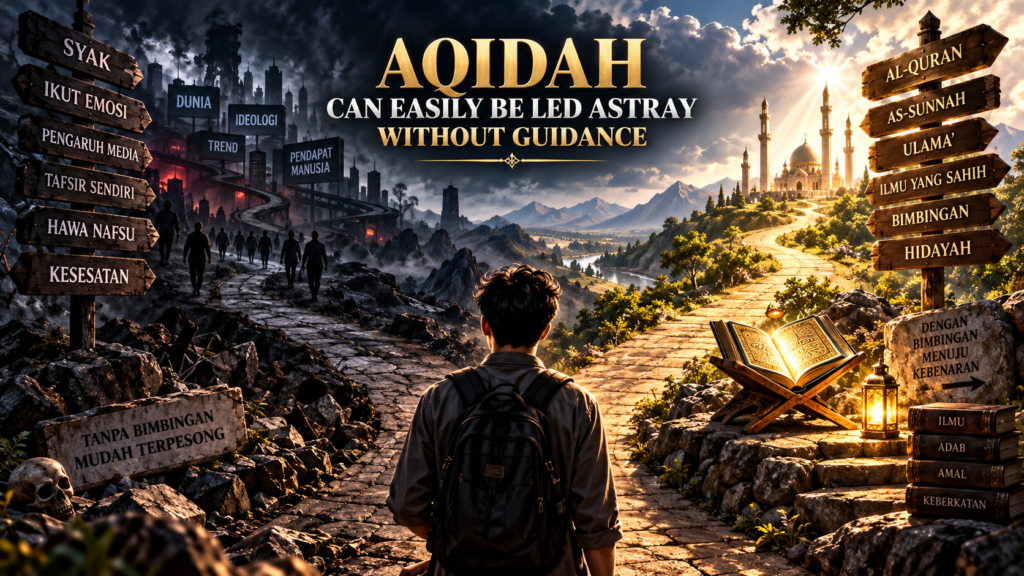
Aqidah is not a subject of memorisation.
Aqidah is not merely knowing how to say:
Allah Exists.
Allah is One.
Allah does not resemble His creation.
Allah is All-Hearing.
Allah is All-Seeing.
All of these statements can be memorised and repeated by the tongue.
But the real question is:
What understanding is the mind forming when the tongue says all these things?
A person may say:
“Allah does not resemble anything.”
Yet within that person’s mind, an image may still exist:
“Allah is an unseen entity, but He is not the same as His creation.”
The words spoken may be correct.
But the understanding formed in the mind may have gone astray.
This is where aqidah can easily be led astray when human beings rely solely on texts, memorisation and translations, without the guidance of someone who is truly knowledgeable.
⸻
AQIDAH REQUIRES GUIDANCE
Allah says:
فَاسْأَلُوا أَهْلَ الذِّكْرِ إِن كُنتُمْ لَا تَعْلَمُونَ
“So ask the people of knowledge if you do not know.”
— Surah An-Naḥl 16:43
This verse itself demonstrates a principle:
If you do not know, do not construct your own understanding.
Ask.
Learn.
Seek guidance.
Because the problem in aqidah is not merely saying something incorrectly.
The problem in aqidah is misunderstanding.
And a small misunderstanding at the beginning can lead a person very far astray in the end.
⸻
THE QURAN IS NOT MERELY TO BE READ
Allah says:
أَفَلَا يَتَدَبَّرُونَ الْقُرْآنَ أَمْ عَلَىٰ قُلُوبٍ أَقْفَالُهَا
“Do they not reflect deeply upon the Quran, or are there locks upon their hearts?”
— Surah Muḥammad 47:24
Pay attention.
The problem is not that they do not have the Quran.
The problem is:
Their hearts remain locked.
Human beings can read.
They can memorise.
They can quote religious evidence.
But understanding has not necessarily opened up.
That is why tadabbur is not merely reading and repeating.
Tadabbur requires:
the mind to be actively engaged,
questions to be opened up,
misunderstandings to be examined,
and the heart to be guided.
⸻
THE DANGER OF KNOWLEDGE WITHOUT GUIDANCE
Allah says:
وَلَا تَقْفُ مَا لَيْسَ لَكَ بِهِ عِلْمٌ
“And do not follow that of which you have no knowledge.”
— Surah Al-Isrā’ 17:36
Yet today, many people dare to speak about aqidah simply because they have:
read a few books,
watched a few lectures,
memorised a few terms,
and obtained a few certificates.
Then they begin to say:
“I already understand.”
“I already know.”
“I can determine who is misguided and who is right.”
This is where the danger begins.
Knowledge is not an abundance of information.
Knowledge is correct understanding.
⸻
WHEN THE TRUE SCHOLARS PASS AWAY
The Messenger of Allah ﷺ said that Allah does not take away knowledge by removing it directly from human beings.
Rather, Allah takes away knowledge by causing the scholars to pass away.
Until, when no knowledgeable people remain, human beings appoint ignorant people as leaders.
They are asked questions.
They issue religious rulings without knowledge.
Consequently, they go astray and lead others astray.
— Narrated by Al-Bukhari and Muslim
This is extremely important.
The Messenger of Allah ﷺ did not say:
“Knowledge disappears because books are destroyed.”
No.
Books may remain.
Libraries may be full.
There may be millions of PDFs.
The internet may preserve the entire Islamic world.
Yet knowledge can still disappear when the bearers of true understanding are no longer present.
This is the difference between:
a book
and
a scholar.
A book preserves the text.
A scholar carries understanding.
⸻
WHEN THE TRUE SCHOLARS ARE GONE, WHO TAKES THEIR PLACE?
The Hadith itself provides the answer:
Human beings appoint ignorant people as leaders.
The problem is that an ignorant person does not necessarily appear ignorant.
That person may:
wear a robe,
wear a turban,
hold certificates,
have titles,
have a platform,
have followers,
have media exposure,
and possess authority.
But the measure of knowledge is not clothing.
It is not titles.
It is not the number of followers.
It is not certificates.
The measure of knowledge is:
Does that person understand?
And more importantly:
Does that person lead others towards understanding, or merely towards memorisation?
⸻
ULAMA SU’ ARE NOT NECESSARILY PEOPLE WHO DELIBERATELY DECEIVE
The greater danger arises when someone does not realise that they have gone astray.
That person genuinely believes they are defending religion.
That person is genuinely convinced that they are right.
But if their understanding stops at texts, memorisation and authority, without reason being properly guided, they may repeat the same mistakes to thousands of people.
Misguidance then spreads in an organised manner.
Not because everyone intends to mislead others.
But because:
Those who do not understand teach others who do not understand.
Those students then teach the next generation.
Eventually, misunderstanding becomes tradition.
And tradition is regarded as religion.
⸻
THE MOST SUBTLE EXAMPLE: AQIDAH
Allah says:
لَيْسَ كَمِثْلِهِ شَيْءٌ
“There is nothing like Him.”
— Ash-Shūrā 42:11
The statement is easy to memorise:
“Allah does not resemble anything.”
But without guidance, the mind may form the idea:
“Allah is something, but He is not similar to His creation.”
It may seem like a small difference.
But from this one mistake, many questions arise:
Where is Allah?
How big is Allah?
Does Allah have a form or not?
Is Allah within space or outside space?
Does Allah move or not?
All these questions can arise because the mind has already placed Allah in the category of an object.
Yet an attribute is not an object.
An attribute is a description.
Allah is described through:
Essence,
Attributes,
and Actions.
Not through an imagined unseen object.
⸻
THE TONGUE MAY BE CORRECT WHILE THE MIND REMAINS WRONG
A person says:
“Allah is not a physical body.”
Yet within that person’s mind, there is still an unseen object without a physical body.
That person says:
“Allah has no form.”
Yet within their mind, there is still an entity whose form is “unknown”.
That person says:
“Allah does not resemble His creation.”
Yet their mind continues to compare Allah with His creation.
This is the danger of aqidah without guidance.
THE TONGUE IS ALREADY CORRECT — BUT THE MIND IS NOT YET CORRECT.
A knowledgeable teacher does not stop at providing an answer.
The teacher asks:
“What do you understand?”
“What are you imagining?”
“Are you treating Allah as an object?”
This is where knowledge begins to come alive.
⸻
WHY DOES THE UMMAH EASILY LOSE ITS DIRECTION?
Because when true scholars become increasingly few, human beings easily come to depend on three things:
books,
certificates,
and popularity.
Books are not wrong.
Certificates are not wrong.
Popularity is not a sin either.
But none of these can replace living understanding.
If human beings only look at who is most famous, who speaks most loudly and who has the most followers, religion eventually becomes a competition for authority.
Not a search for truth.
⸻
RATIONAL PROOF AND TRANSMITTED PROOF MUST WORK TOGETHER
Allah repeatedly calls upon human beings to think.
Among these calls are:
أَفَلَا تَعْقِلُونَ
“Will you not use your reason?”
And:
أَفَلَا تَتَفَكَّرُونَ
“Will you not reflect?”
Islam does not teach human beings to suppress their reason.
But reason must not operate without revelation either.
Therefore, the path is:
The revealed texts guide reason.
Reason understands the revealed texts.
Not:
Memorise the texts and then shut down reason.
And not:
Use reason and then discard the texts.
⸻
TRUE SCHOLARS OPEN THE MIND RATHER THAN CLOSE IT
A knowledgeable teacher is not afraid of students asking questions.
The teacher does not become angry when students think.
The teacher does not turn:
“Do not ask.”
into the answer to every question.
The teacher will guide.
The teacher will distinguish between concepts.
The teacher will explain the boundaries.
The teacher will correct the categories.
Because the purpose of a teacher is not to produce people who know how to repeat information.
The purpose of a teacher is to produce people who:
understand,
are aware,
and have conviction.
⸻
AQIDAH CANNOT DEPEND ON BLIND IMITATION
Allah says:
وَإِذَا قِيلَ لَهُمُ اتَّبِعُوا مَا أَنزَلَ اللَّهُ قَالُوا بَلْ نَتَّبِعُ مَا أَلْفَيْنَا عَلَيْهِ آبَاءَنَا
“When it is said to them: Follow what Allah has revealed, they say: Rather, we follow what we found our forefathers following.”
— Surah Al-Baqarah 2:170
Tradition is not absolute proof.
The majority is not absolute proof.
Something being long-established is not absolute proof.
A title is not absolute proof.
Everything must return to:
the revealed texts,
reason,
and guided understanding.
⸻
CONCLUSION
Today, human beings have more books than previous generations.
More recordings.
More lectures.
More applications.
Greater access.
But access to information does not necessarily mean access to knowledge.
Because knowledge is not merely text.
Knowledge is understanding.
And understanding requires:
reason,
tadabbur,
guidance,
and a truly knowledgeable teacher.
The Messenger of Allah ﷺ has already warned:
When the scholars pass away, human beings will appoint ignorant people, who will then issue religious rulings without knowledge and ultimately go astray and lead others astray.
Therefore, do not merely ask:
“What books has that person read?”
Also ask:
“Does that person truly understand?”
Do not merely ask:
“What certificates does that person hold?”
Ask:
“Does that person open the way to understanding, or merely increase memorisation?”
And in aqidah, the most important question is:
“Has what is spoken by the tongue truly been understood by the mind and recognised by the heart?”
Because:
AQIDAH WITHOUT GUIDANCE CAN EASILY BECOME MERE MEMORISATION.
MEMORISATION THAT IS MISUNDERSTOOD CAN EASILY LEAD TO MISGUIDANCE.
And when misunderstandings are inherited from generation to generation:
Human beings may believe they are defending religion, when in reality they are merely defending an interpretation that has never been examined.