
QIAMAH
The Effects of SO₂ on Human Beings
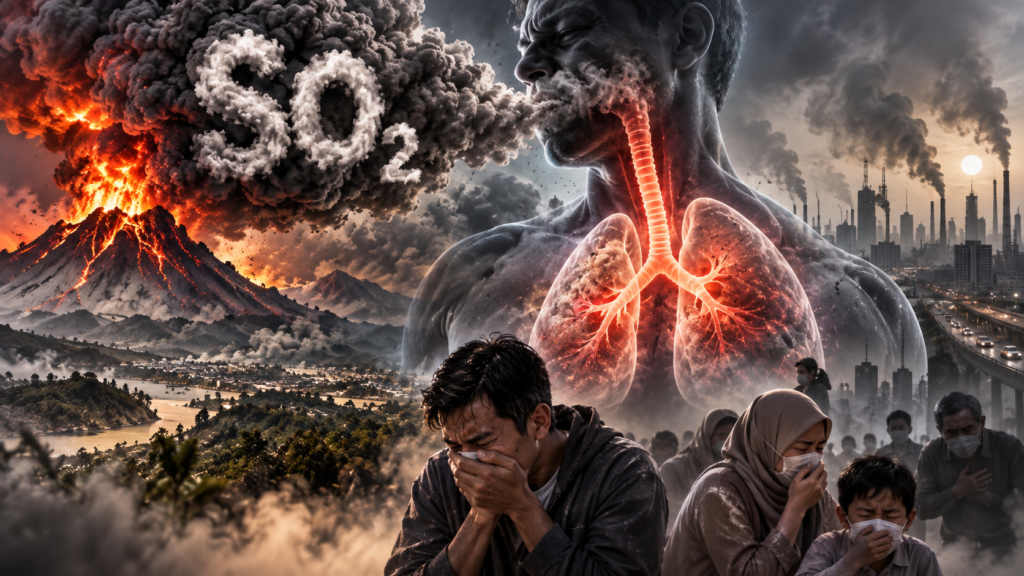
VOLCANIC ERUPTIONS, LARGE-SCALE FIRES AND ACID RAIN
Sulfur dioxide, or SO₂, is a gas that can be produced by several sources, including volcanic eruptions and the combustion of sulfur-containing fuels. Volcanoes can release large amounts of SO₂, and during extremely large eruptions, this gas can be carried over long distances by the wind and enter the upper layers of the atmosphere.
SO₂ is not a virus.
SO₂ is also not a coronavirus.
However, SO₂ shares one important characteristic with many respiratory threats:
IT ENTERS THE BODY THROUGH THE AIR WE BREATHE.
When human beings inhale air containing SO₂, the gas can irritate the eyes, nose, throat and, most importantly, the respiratory tract.
Possible effects include:
eye, nose and throat irritation,
coughing,
chest tightness,
difficulty breathing,
narrowing of the airways,
inflammation of the respiratory tract,
and reduced lung function.
People with asthma or lung disease are more susceptible to its effects.
⸻
WHEN VOLCANOES RELEASE SO₂
Volcanic eruptions do not merely release lava and ash.
They can also release gases such as:
SO₂ — sulfur dioxide.
When SO₂ is released into the atmosphere, it can travel according to wind direction and speed.
Under certain conditions, SO₂ can react with water vapour and other substances in the atmosphere to form sulfate aerosols and sulfuric acid.
Therefore, the dangers of an eruption are not limited to those standing near the crater.
Under certain conditions, pollution clouds can travel long distances through the atmosphere.
⸻
WHAT HAPPENS WHEN SO₂ COMES INTO CONTACT WITH WATER IN THE ATMOSPHERE?
In the air, SO₂ can undergo chemical reactions and form sulfates and sulfuric acid.
These fine particles can remain in the atmosphere before some of them eventually return to the surface through dry deposition or rainfall.
This is one of the processes associated with the formation of acid rain.
However, one point must be clarified:
HUMAN BEINGS ARE NOT PRIMARILY THREATENED BY “INHALING ACID RAIN.”
The greater danger comes from SO₂ and sulfate particles that remain in the air, because these substances can be inhaled into the lungs.
Therefore, the sequence is more accurately described as follows:
Eruption / combustion → SO₂ is released → disperses through the atmosphere → reacts to form sulfates/acids → some is inhaled as gas or fine particles → some returns to the surface with rainfall.
⸻
LARGE-SCALE FIRES CAN ALSO INCREASE THE POLLUTION BURDEN
Large-scale fires produce a complex mixture of pollutants.
Depending on what is burning, smoke may contain:
* fine particles,
* carbon monoxide,
* nitrogen oxides,
* sulfur dioxide,
* volatile organic compounds,
* and various other toxic substances.
If very large fires occur simultaneously with volcanic emissions, human beings may face a mixture of air pollutants rather than a single substance.
Under such circumstances, the effects depend on:
pollutant concentration, duration of exposure, wind direction, weather conditions and distance from the source.
⸻
THE EFFECTS OF SO₂ ON THE BODY
The most apparent effects are on the respiratory system.
SO₂ can cause:
Irritation of the nose and throat
A stinging, burning or uncomfortable sensation.
Coughing and chest tightness
SO₂ can irritate the airways and cause difficulty breathing.
Narrowing of the airways
This is particularly important for people with asthma.
Inflammation of the respiratory tract
SO₂ can cause airway inflammation and increase mucus production.
Reduced lung function
During high-level short-term exposure, lung function may deteriorate.
However:
SO₂ IS NOT A TYPICAL CAUSE OF “MUSCLE INFLAMMATION.”
Its primary targets are:
the eyes, nose, throat and respiratory system.
⸻
COVID-19 CAN CAUSE MUSCLE AND BODY PAIN
This is where an important distinction arises.
COVID-19 can affect not only the respiratory system but can also cause:
muscle pain,
body aches,
joint pain,
fatigue,
and, in some patients, persistent pain after infection.
The medical term is:
MYALGIA — muscle pain.
Some patients describe it as:
“aching muscles and tendons,”
“aches throughout the body,”
“sore muscles,”
or “feeling as though the body has been beaten.”
In some cases of Long COVID, muscle and joint pain can persist after the acute infection has resolved.
⸻
SO, DO SO₂ AND COVID HAVE THE SAME EFFECTS?
Not entirely.
They differ in their causes and mechanisms.
COVID-19
* is caused by a virus,
* can trigger an immune response throughout the body,
* can cause fever, myalgia, joint pain and fatigue,
* and can also affect the lungs.
SO₂
* is a pollutant gas,
* does not infect or replicate,
* primarily causes effects through chemical irritation of the respiratory tract,
* and does not typically cause muscle pain as a direct effect.
However, they can converge at one point:
THE HUMAN RESPIRATORY SYSTEM CAN BE A PRIMARY SITE OF THEIR EFFECTS.
⸻
FINE PARTICLES CAN BE EVEN MORE CONCERNING
SO₂ in the atmosphere can produce extremely small sulfate particles.
Fine particles such as PM₂.₅ can penetrate deep into the lungs.
Fine particulate air pollution does not merely affect the lungs; it is also associated with effects on:
the heart, blood vessels and other organs.
That is why pollution from volcanic eruptions cannot be assessed on the basis of SO₂ alone.
The mixture of:
gas + ash + aerosols + fine particles
can be far more complex.
⸻
CAN SO₂ SPREAD ACROSS THE ENTIRE WORLD?
Extremely large eruptions can inject SO₂ into the upper atmosphere, including the stratosphere.
There, SO₂ can transform into sulfate aerosols and spread widely through atmospheric circulation.
However, this does not mean that every volcanic eruption will fill the entire Earth with SO₂ at dangerous concentrations.
Global effects depend on:
the size of the eruption,
the amount of sulfur,
the height of the eruption plume,
wind direction,
and atmospheric conditions.
⸻
WHEN CLOUDS, RAIN AND SO₂ INTERACT
It is more accurate to say that SO₂ and its sulfur-containing reaction products can interact with water vapour, aerosols and clouds, with some eventually being removed from the atmosphere through rainfall.
This does not mean that an “SO₂ cloud” necessarily collides with an ordinary cloud, causing all the gas to descend to Earth simultaneously.
The atmosphere is far more complex than that.
Nevertheless, the broader principle remains true:
WHAT IS RELEASED INTO THE AIR CAN CIRCULATE, UNDERGO REACTIONS AND EVENTUALLY RETURN TO THE EARTH’S SURFACE.
⸻
ERUPTIONS + MASSIVE FIRES = A DANGEROUS MIXTURE OF POLLUTANTS
If the world were to experience numerous large-scale fires at the same time as several volcanic eruptions, the atmosphere could receive large quantities of:
smoke,
ash,
SO₂,
carbon monoxide,
nitrogen oxides,
and fine particles.
The concern is not limited to a single substance.
What is more dangerous is the mixture of pollutants that human beings inhale day after day.
⸻
NOT A VIRUS — BUT THE LUNGS REMAIN A PRIMARY SITE OF EXPOSURE
SO₂ does not replicate.
It does not contain RNA.
It does not have a spike protein.
It does not infect human beings.
But when it enters with the air we breathe:
the respiratory tract remains the main route of entry.
That is why someone exposed to polluted air may experience:
throat irritation → coughing → shortness of breath → bronchospasm → reduced lung function,
depending on the concentration and duration of exposure.
COVID, on the other hand, can additionally cause:
fever → body aches → myalgia → fatigue → joint pain,
alongside its effects on the respiratory system.
Therefore, the two are not the same, but both demonstrate one thing:
HOW VULNERABLE HUMAN BEINGS ARE WHEN THE VERY AIR THEY BREATHE BECOMES A DANGER.
⸻
THE LESSON
A volcano may erupt far from a city.
A fire may occur far from our homes.
But the atmosphere does not have borders like countries do.
Wind can carry pollution.
Aerosols can travel.
Rain can bring some substances back to Earth.
And ultimately, human beings must still perform the most basic act necessary for survival:
BREATHE.
COVID has shown that respiratory threats can be accompanied by:
coughing, shortness of breath, fatigue and muscle pain.
SO₂, meanwhile, demonstrates that polluted air itself can become a threat even in the absence of a virus.
Therefore, the larger question is not merely:
“What is falling from the sky?”
But:
“WHAT IS ALREADY PRESENT IN THE AIR BEFORE WE TAKE OUR NEXT BREATH?”